
The standard pitch for any new luxury launch on Golf Course Extension Road sounds almost identical premium 3 and 4 BHK, glass towers, a clubhouse the size of a hotel, and a price tag that climbs every quarter. Read three brochures side by side, and the only variables are the name on the gate and the per-square-foot rate. That uniformity is itself the story of the corridor in 2026: an arms race in finishes, not in fundamentals.
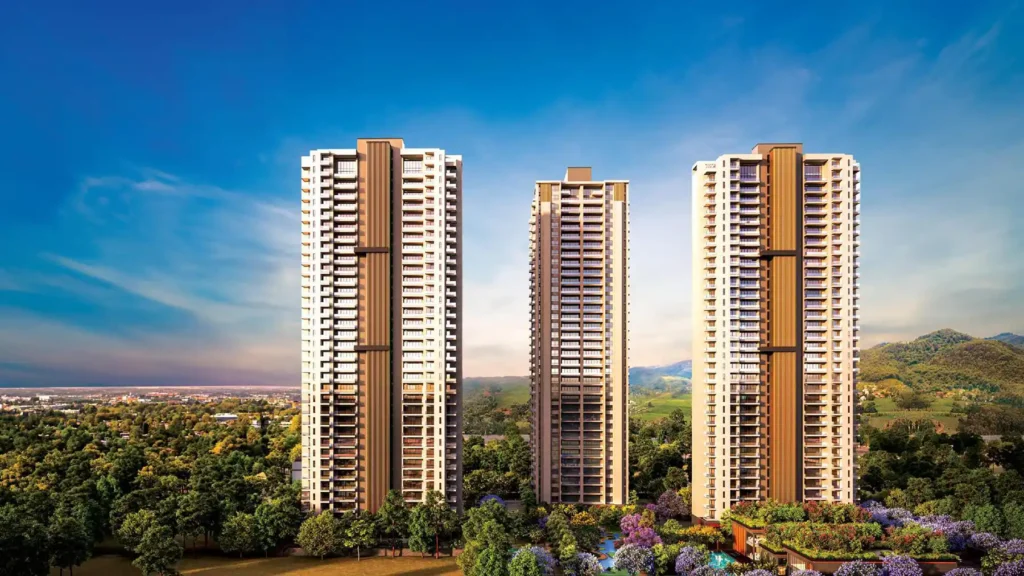
Against that backdrop, Silverglades Legacy in Sector 63A is taking a different position. The project occupies 10.5 acres with only 5 towers, offers configurations stretching from 2,800 sq. ft. 3 BHK to 7,700 sq. ft. duplex penthouses, and is being built by a developer whose four-decade portfolio is rooted in golf-based and low-density residential work rather than tower-stack volumes. For buyers comparing the eight or nine credible launches currently active on Golf Course Extension Road, the meaningful question is not whether Silverglades Legacy Gurgaon looks luxurious, every project does, but where the structural differences sit.
The density question: 410 apartments on 10.5 acres
Density is the single most under-discussed variable in NCR premium-segment marketing material. Most new luxury towers on Golf Course Extension Road and the adjacent Sector 65–67 belt are being planned at 180 to 250 apartments per acre once the full master plan is loaded, a number rarely shared with prospective buyers but visible in the approved building plans. Silverglades Legacy is currently configured for 410 apartments across 10.5 acres, which works out to roughly 39 units per acre across the entire site.
That ratio matters in three operational ways. First, lift-and-lobby wait times: a tower with eight apartments per floor and three lifts behaves very differently from one with three apartments per floor. Second, parking egress at peak hours, which is the single most frequent post-possession complaint on RERA grievance portals for new Gurugram launches. Third, the actual usability of the clubhouse and amenity deck, a 10,000 sq. ft. pool serving 410 households, is a fundamentally different experience from the same pool serving 1,200 households in a higher-density project two sectors away.
None of this guarantees a better daily experience, it depends on execution, but it sets a structural ceiling that higher-density projects on the same road cannot match without redesign.
Configuration range: from 3 BHK to 7,700 sq. ft. duplex penthouses in one address
Most luxury launches on Golf Course Extension Road are configured tightly, typically 3 and 4 BHK in a 2,500 to 3,800 sq. ft. band, designed for a single buyer demographic. Silverglades Legacy Sector 63A Gurgaon spans a much wider envelope: 3 BHK apartments at 2,800 sq. ft., 4 BHK at 3,800 and 4,800 sq. ft., 4 BHK penthouses at 4,200 sq. ft., and two penthouse formats topping out at 5,900 and 7,700 sq. ft.
This range has a practical implication for resale and rental dynamics. Single-configuration projects tend to compete with themselves at exit; every owner is selling effectively the same product to the same buyer pool. A mixed-format community creates micro-markets within the same address, where the 3 BHK rental yield curve, the 4 BHK upgrade-buyer curve, and the penthouse trophy-asset curve operate independently. For NRI and HNI buyers using residential real estate as a long-hold instrument, that internal diversification is rarely modelled but materially affects holding-period outcomes.
The developer track record: legacy in the literal sense
Golf Course Extension Road has attracted, in roughly equal measure, India’s largest listed developers and a wave of newer entrants riding the corridor’s appreciation curve. Silverglades sits in neither camp. The Silverglades Group’s portfolio leans on golf-based leisure developments, township-scale projects in Kasauli and Gurugram, and earlier residential work that has had time to be tested in resale and possession-quality terms, the only test that ultimately matters in Indian luxury real estate.
Industry observers tracking the corridor note that developer-track-record differences are widening, not narrowing. A 2026 Knight Frank India analysis on premium-segment resale velocity in NCR found that projects from developers with sub-15-year possession histories were trading at meaningful discounts to comparable inventory from longer-tenured developers, a gap absent from the corridor as recently as 2021. The implicit market judgement is that promise and delivery are not the same thing, and that buyers are beginning to price that gap in.
“What’s quietly shifting in the corridor is that buyers are starting to underwrite the developer almost as carefully as the project. Possession history is becoming the new amenity.” Senior Real Estate Investment Advisor, Delhi NCR Market
Location: Sector 63A’s positioning inside the corridor
Within Golf Course Extension Road, Sector 63A sits at the intersection of two trajectories. To the west, it connects via the Southern Peripheral Road to the established Golf Course Road luxury belt, DLF Phase 5, Sector 42, Sector 53, where ticket sizes have plateaued near their resistance band. To the east and south, it borders the high-growth Sector 65-69 corridors, where new launches continue to absorb. That intermediate position gives Sector 63A an unusual property: comparables in both directions.
On documented connectivity, the site is approximately 6.2 km from Sector 55–56 Rapid Metro, 24 km from Indira Gandhi International Airport via NH-48, and within a 15-minute drive of the DLF Cyber City and Cyber Hub commercial cluster outside peak hours. Education and retail are dense in the immediate radius, with established schools including Heritage Xperiential Learning School within 5 km and the WorldMark Gurgaon retail district within 3 km. None of this is unique to Silverglades Legacy; most projects on the corridor share the same connectivity, but it establishes the locational floor.
Amenity programming: where the differentiation actually lives
Every project on Golf Course Extension Road advertises a clubhouse, swimming pool, gym, jogging track, and landscaped gardens. The amenity list at Silverglades Legacy Primo Gurgaon reads similarly on first pass: 24/7 security, multi-purpose hall, lifts, rainwater harvesting, Vastu compliance, and landscape gardens. The differentiation begins where the list gets specific: a sky bridge across towers, a padel ball court, a skating rink, a half basketball court, a reflexology park, cabanas, chef-on-call service, golf cart shuttles within the community, a dedicated pet park, and creche facilities.
Two observations. First, the inclusion of a padel court signals an awareness of the actual usage patterns of NCR HNI segment in 2026. Padel has displaced standard tennis as the dominant racquet sport in Delhi-Gurugram club memberships over the past 24 months. Second, the golf-cart shuttle inclusion is a Silverglades signature that traces directly to the group’s golf-based developments elsewhere a low-key but meaningful internal mobility upgrade in a 10.5-acre community.
What buyers should weigh against the upside?
An honest comparison includes the risks. The Golf Course Extension Road luxury micro-market is experiencing rapid supply expansion through 2026 and 2027 RERA filings for the broader corridor show a meaningful spike in approved inventory crossing possession dates over the next 36 months. That supply pipeline could compress rental yields below the 3% range that long-hold investors typically demand. Resale velocity, which has been historically strong on the corridor, may also normalise as inventory catches up with demand.
For Silverglades Legacy specifically, the entry ticket starting at ₹7.35 Cr for the 3 BHK places it firmly in the upper premium band a price point where the buyer pool narrows considerably, and exits depend more on macro liquidity than on locality fundamentals. Buyers underwriting this as a primary residence will find the value proposition cleaner than buyers underwriting it as a pure investment vehicle.
Some analysts also note that low-density luxury projects, while better to live in, tend to have a smaller secondary-market depth than larger high-density projects, a paradox where the lifestyle premium and the liquidity premium move in opposite directions.
The structural differences, summarised
- Density: Approximately 39 units per acre across 10.5 acres, meaningfully below the corridor average for new luxury launches.
- Configuration spread: 3 BHK to 7,700 sq. ft. duplex penthouses in a single address. Internal market diversification is rare in the corridor.
- Developer tenure: A four-decade portfolio with delivered, tested inventory increasingly priced in by HNI buyers in 2026.
- Amenity specificity: Padel court, sky bridge, in-community golf carts, and chef-on-call reflecting actual 2026 HNI lifestyle patterns rather than a generic luxury checklist.
- Location balance: Sector 63A positioning between mature Golf Course Road and high-growth Sector 65–69, with comparables in both directions.
The takeaway
Silverglades Legacy is not different from other Golf Course Extension Road launches because it offers a better swimming pool or a more aspirational marketing campaign, every project on the corridor competes credibly on those axes. The differences that hold up to scrutiny are structural: lower unit density on a larger land parcel, a wider configuration range that creates internal market diversification, and a developer whose track record predates the corridor’s appreciation cycle rather than being created by it.
Whether those structural differences translate into superior outcomes will depend, as it always does in Indian residential real estate, on execution discipline and the macro absorption trajectory over the next 24 to 36 months. For buyers narrowing a Golf Course Extension Road shortlist in 2026, the more useful question is not which project is most luxurious, but which set of structural choices best matches the buyer’s intended holding period and exit assumption.